IN 30 SECONDS
- In any serious valuation, two identical companies are worth different amounts if they operate under legal frameworks with different levels of predictability: the buyer demands a higher return for the uncertainty, and that lowers the price they're willing to pay.
- That adjustment has a name, country risk premium, and it's added to the discount rate used to value a company: the higher it is, the lower the present value.
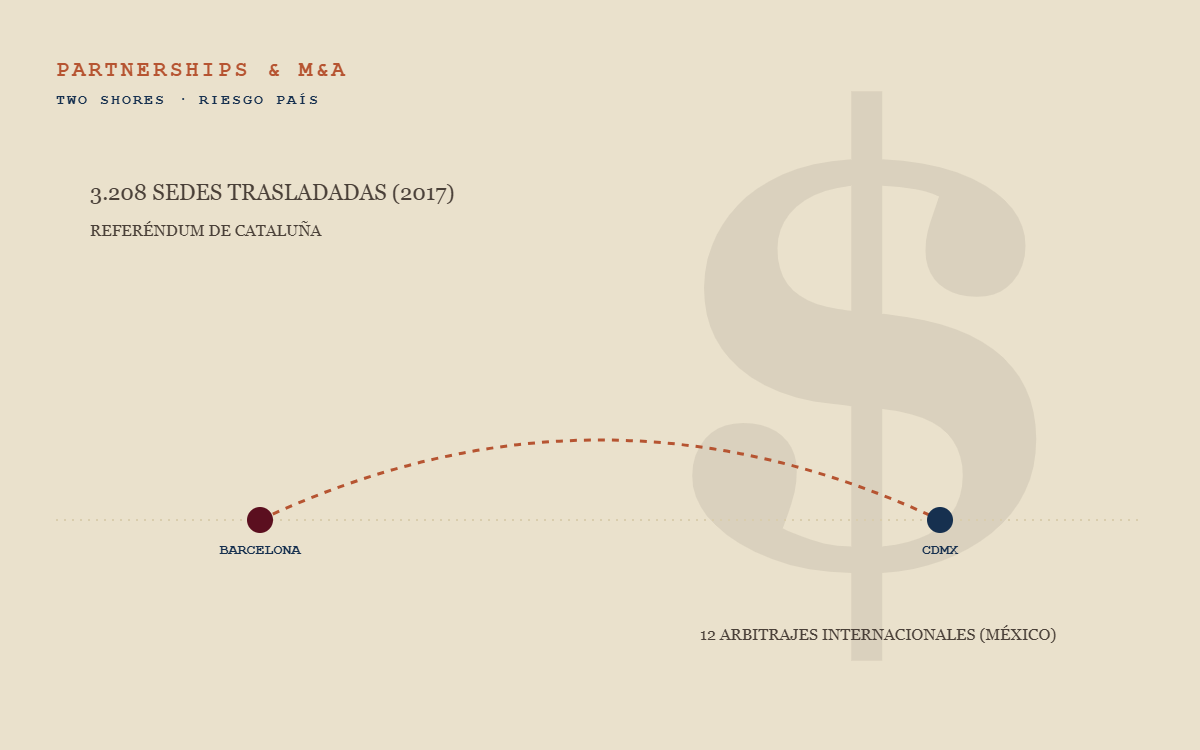
- The discount doesn't wait for the law to change: after Catalonia's 2017 referendum, 3,208 companies applied to move their registered address out of the region in a single quarter, according to Spain's Registrars' Association, before a single new article of law existed.
- In Mexico, with the judicial reform passed in 2024 and implemented in 2025, ICC Mexico counted twelve active international investment arbitrations as of June 2025, and the OECD points to uncertainty over the judicial system: the market is already pricing in the risk.
Take two identical companies: same revenue, same margin, same team, same product. One is headquartered in Zurich. The other is in a country where the regulatory framework has changed three times in the last five years. In any serious valuation exercise, the second one is worth less. Not because the business is worse. Because whoever is putting up the money to buy it demands a higher return in exchange for accepting more legal uncertainty, and that additional return comes straight out of the price they're willing to pay.
That mechanism has a name in valuation practice: country risk premium. It's added to the discount rate used to bring a company's future earnings back to present value. The higher the rate, the lower the present value. And part of that premium — sometimes the largest part — doesn't measure whether the economy is going to grow. It measures how predictable the law is under which that company operates. A judicial system the market has doubts about, a tariff framework that changes by decree, a reform that reopens the rules of the game midway through — all of that translates, formula and all, into a number that lowers the sale price.
When Fear Arrives Before the Law Does
What's interesting is that this discount doesn't wait for the law to change. Catalonia is Spain's clearest example. After the independence referendum of October 2017, 3,208 companies applied to move their registered address out of the region in a single quarter, according to Spain's Registrars' Association. CaixaBank and Banco Sabadell, two of the country's largest banks, moved their registered address to the Valencia region that same month. CaixaBank is still there; Sabadell didn't approve its return to Catalonia until January 2025, more than seven years later. It wasn't a reaction to a law that already existed: it was a reaction to the possibility that the rules might change, and that possibility alone was enough to move headquarters that had been in the same place for decades.
After the October 2017 referendum, 3,208 companies applied to move their registered address out of Catalonia in a single quarter, before a single new article of law existed.
Mexico is living a different version of the same phenomenon with the judicial reform passed in 2024 and implemented in 2025 with the first popular election of judges. In June 2025, ICC Mexico counted twelve active international investment arbitrations against the country, mostly in mining, energy and the financial sector, warning that the reform could change the rules of the game in key sectors. In December, the OECD noted that the reform, given its depth, has generated uncertainty about how the judicial system functions, affecting domestic investors and small and midsize businesses above all. International arbitration, it's worth noting, isn't a tool used when everything is going well: it's the mechanism an investor turns to when they'd rather pay the cost of litigating abroad than depend on local certainty.
In June 2025, ICC Mexico counted twelve active international investment arbitrations against the country; in December, the OECD pointed to uncertainty over the judicial system. The market is already pricing in the risk.
Why This Isn't Just a Government Problem
Here's the part that matters to anyone evaluating a purchase, a sale, or an expansion into a new country: this risk almost never gets put on the table as a number. It gets talked about as a feeling ("that country makes me a little nervous right now") instead of being treated for what it is — a variable that already has a methodology, published rates (Damodaran's country risk premiums are updated every January), and documented precedent. That means two buyers can be evaluating the same opportunity, one correctly discounting the country's legal risk and the other ignoring it, and arrive at very different valuations without either one realizing why.
Legislation doesn't just change what a company can or can't do. It changes, with a formula behind it, how much that company is worth on the day someone wants to buy it, sell it, or partner with it. And the effect isn't always proportional to the size of the reform: sometimes it's enough for the possibility of a change to enter the public conversation, as in Catalonia in 2017, for capital to move before a single new article of law exists.
What to Do About It in Practice
Before evaluating an opportunity in a new jurisdiction, it's worth treating legal-regulatory risk as another line in the analysis, not a footnote. Three concrete questions help turn the feeling into a number: how many active international arbitrations does this country have, and in which sectors are they concentrated? Is there a documented — not anecdotal — trend regarding the predictability of its courts or regulators over the last five years? How quickly has capital moved out of the region the last time there was a sign of instability, and how long did it take (if it did) to come back?
None of those questions eliminates the risk. But they do avoid the most common mistake, which is discovering the discount after signing, when it's already too late to ask for it.
Related resource: Capstone Partners: M&A in the Beverage Sector (March 2026), on how M&A capital is moving in an environment where regulatory risk also weighs on every deal.
Sources
- Spain's Registrars' Association (Colegio de Registradores), registered-address relocations out of Catalonia, fourth quarter of 2017 (3,208 applications)
- Banco Sabadell approves the return of its registered address to Catalonia, January 22, 2025, via The Objective
- ICC Mexico, twelve active international investment arbitrations against Mexico, via Proceso (June 17, 2025)
- OECD (Alberto González Pandiella), presentation of the Latin American Economic Outlook, via El Financiero (December 3, 2025)
- Aswath Damodaran (NYU Stern), Country Risk Premiums, January 2026 update